
No Bullsh*t Strategy for social ventures
I recently read No Bullsh*t Strategy by Alex M H Smith. It got me thinking about how his approach to strategy applies to social ventures.
I’ll start with a quick tour of the ideas set out in the book and then I’ll explain how the ideas relate both to Alex Osterwalder’s concept of business model innovation and Simon Sinek’s manifesto-like Start With Why. All three of these ways of thinking from Alex M H Smith, Alex Osterwalder and Simon Sinek, have originally been created with pure for-profits in mind. However, all three provide a valuable framework for thinking about social venture strategy and I feel all three frameworks are complimentary to each other.
Alex M H Smith’s No Bullsh*t Strategy (largely paraphrased)
Smith sees strategy as the unique value a business provides to the market. The role of strategy, he suggests, is to promote and encourage action. He explains that the market doesn’t really care about better but it does care about different. It’s no good aiming to be better than the competition, it’s only worth while being different. Of course, people need to want that different that you’re offering.
He sees the whole business model of a business as comprised of strategy, delivery and marketing. Strategy is what you deliver, delivery is how you deliver it and marketing is how you communicate it. Strategy is the unique value you’re providing to the market, delivery is how you deliver this value through products and services and marketing is how you communicate this value to the outside world.
An important caveat highlighted in the book is that a goal is not a strategy i.e. To help a million people to do X, is not a strategy, it’s a goal.
As always, Apple is used as an example (well, the original, Steve Jobs, Apple):
- Their goal: To get a personal computer into the hands of everyday people
- Their strategy: To create computers that are intuitive, friendly and accessible
- Their delivery: Through cute, simple, toy-like devices such as the old colourful iMacs
- Their marketing: Think different, supported by advertising campaigns that extol this mindset such as “Here’s to the crazy ones”.
In a similar manner to Blue Ocean Strategy by Renée Mauborgne and W. Chan Kim, Alex suggests that different is better than better. In what could be seen as a summary of Blue Ocean Strategy, Alex sees the goal as to create a new category of one. Start inside a recognised category that the market understands and then push the boundaries to create a new category that is also recognisable. This is what Alex calls pushing out of a category or weirding the normal. Equally, he suggests, if you have a new innovation that is unrecognisable to the market, the opposite is important to do, to push into a category in order to ensure people understand and can connect with the service or product.
What I found refreshing is that Alex provides a methodology for creating a strategy and suggests that you might not have a strategy to begin with but that by listening deeply to your own business you can
“Find out who you are and do it on purpose” (Alex quoting Dolly Parton).
His process is:
- Put something out in the world
- See what people get behind and connect with
- Double down on this personality
He calls this finding the latent strategy within the business and leaning in to it.
Alex also discusses the importance of understanding who your competitors really are. This is very similar to part of the discussion within Jobs-To-Be-Done theory and he discusses the example of Harley Davidson’s competitors not being Yamaha, or Suzuki or other bike manufacturers, but rather a conservatory.
His methods for creating a category of one include:
- Context shift: Take a product that ordinarily fits in one category and compete in a different category where it is unique. e.g. A cereal bar that should compete with other cereal bars being placed within the confectionary category where it might be seen as a “healthier” alternative.
- Unexpected value: Take a perceived weakness and turn it into a unique strength e.g. Games console manufacturers competed on power and spec of their consoles. Nintendo did the opposite, they purposely leant into a less powerful console that allowed them to create a handheld device (Nintendo Switch) that went on to dominate a category of its own.
What I like most about Alex’s book is his suggestion for how to discover your strategy…. Go talk to humans 1-on-1. This I totally agree with. Essentially, he asks his audience to co-produce their strategy with their community.
Alex Osterwalder’s concept of business model innovation
I’m a huge fun of the Business Model Canvas and Value Proposition Canvas but what I like most is how they support Alex Osterwalder’s concept of business model innovation.
There is a link here to what Alex M H Smith is saying too when he discusses expanding the creative canvas on which we innovate beyond the boundaries of marketing and product to strategy.
Alex M H Smith calls strategy the unique value a business provides to the market. The Value Proposition Canvas is, in my eyes (and many others), the tool to use to understand the value your business provides to customers. It really does provide a great way to pull out the assumptions the I would test in the real world to understand is this the right strategy to take.
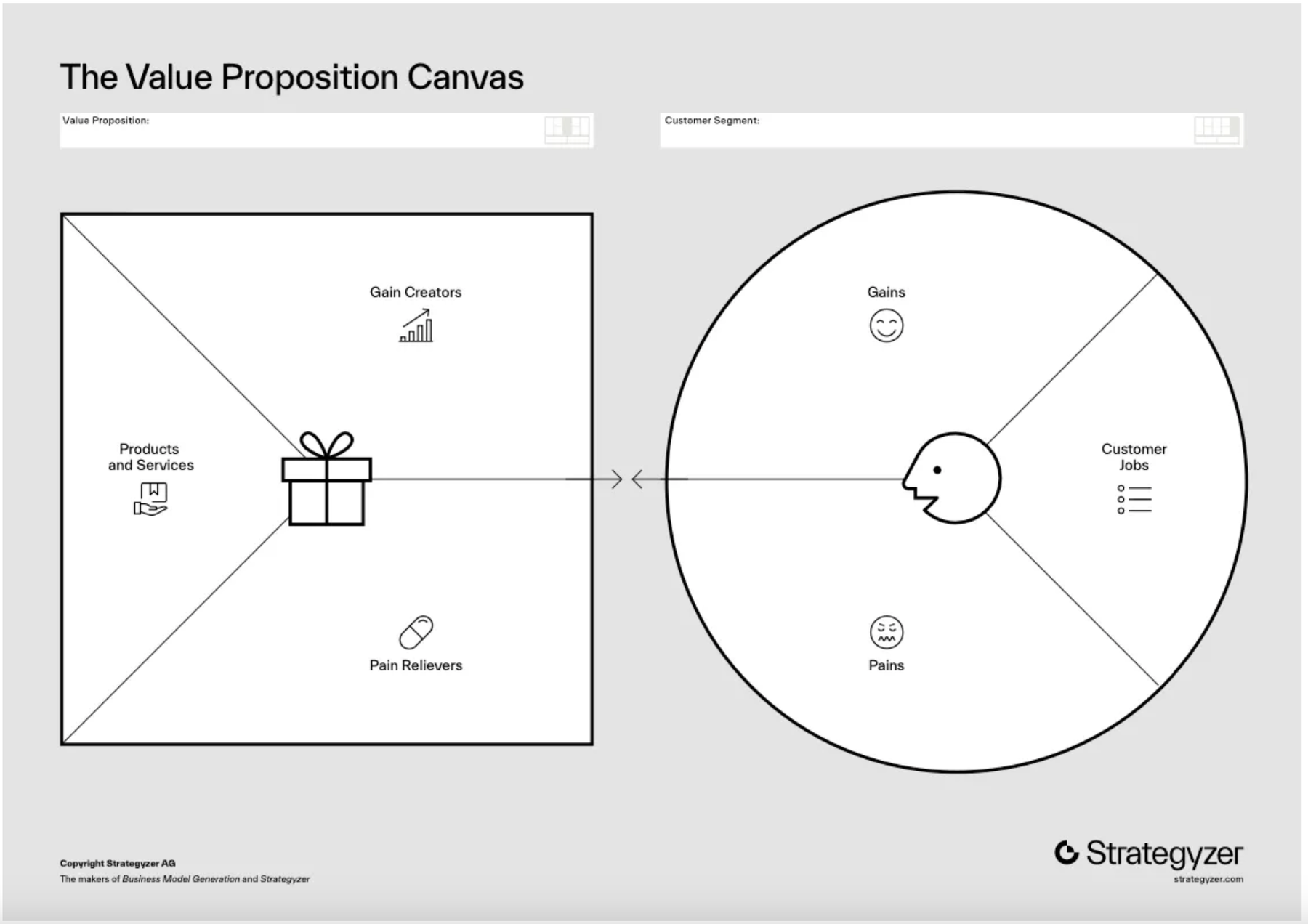
I’d use the Value Proposition Canvas first and then pull out the strategy or unique value the business is delivering to the market from this.
The Value Proposition Canvas, on the right hand side is promoting deeply understanding your customer, getting out there and speaking to them, to understand their jobs, pains and gains. This completely connects with Alex M H Smith’s call to find out your strategy by speaking to the market.
After filling out the right side of the canvas, I use creativity with the left hand side, trying to put together a value proposition that meets the needs of the market whilst delivering something uniquely valuable.
When Alex M H Smith’s book provides a good description of what strategy is and isn’t, the Value Proposition Canvas provides a framework to get to that strategy.
Simon Sinek’s Start With Why
It was really fascinating reading how Alex M H Smith views the concept Start with why. He gets to the core of the concept fast. He sees starting with why as a leadership tool that motivates you and your team to take action.
Interestingly, he also says that strategy’s main function is to motivate you and the team to take action.
I agree, I think this about every step taken in the early stages of a venture. It’s all about taking action, having the courage to actually do things in the real world. To get out of your head and out there as fast as possible.
Strategy and social ventures
The goal of all social ventures on a more generic front is to achieve social or environmental good. I often feel pulled towards seeing my impact statement as my strategy. Reading Alex M H Smith’s book made me reconsider this. My impact statement is my goal but it isn’t the strategy for achieving that goal. The strategy is the unique approach I take to achieving this impact.
In all my social ventures my goals are to amplify or accelerate the social impact of other social ventures (charities, social enterprises, community organisations or public sector orgs). But each of my social ventures take a very different strategy to achieving this.
Arguably, the understanding of the strategy helps social ventures to approach social good in a manner that is complimentary to the other organisations working on this impact goal rather than in a way that is competing for resources and diminishing the overall collective impact.
In a world where real impact comes from collective impact, strategy as explained by Alex M H Smith, becomes vital to understand. How do our individual strategies lead to great collective impact? That’s the question I need to understand – what are my social ventures uniquely contributing on this journey to better?